
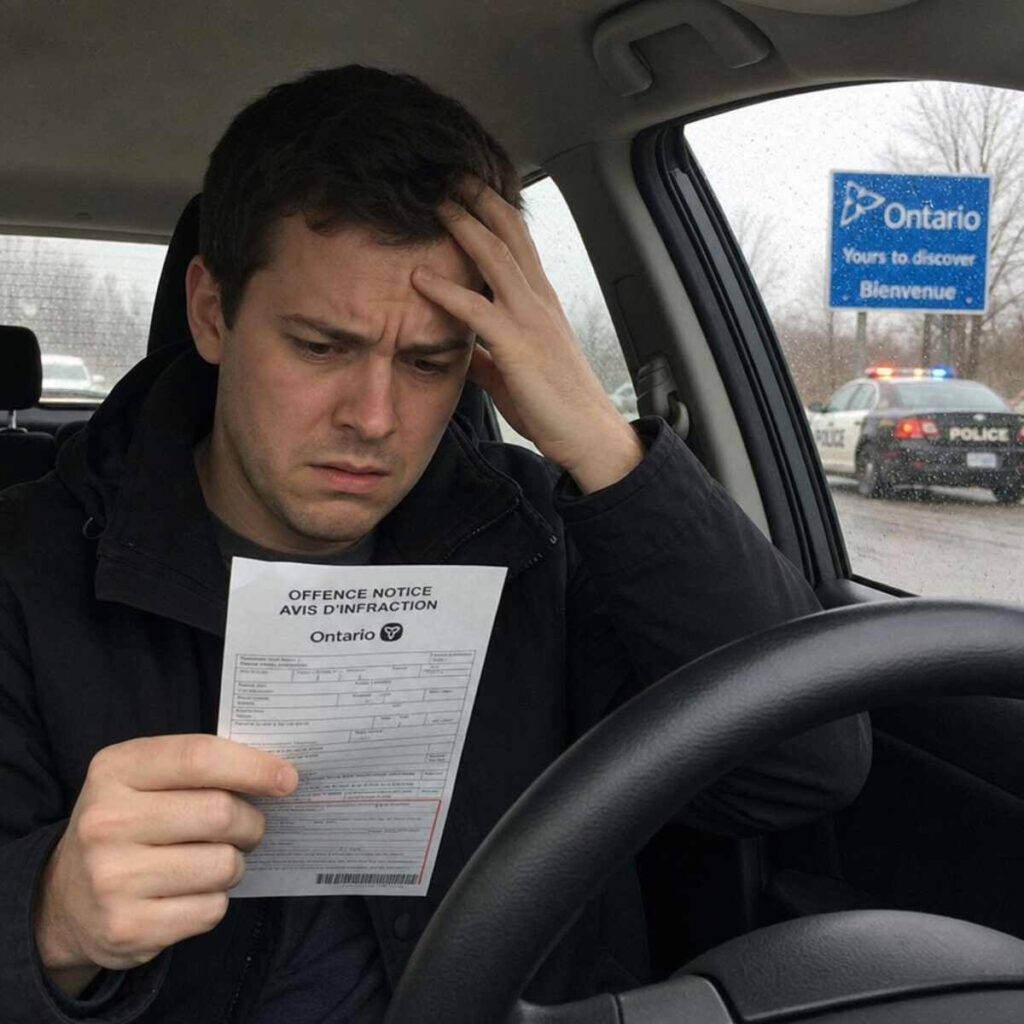
Seeing the flashing red and blue lights in your rearview mirror is a universally stressful experience. Whether you accidentally let your speed creep up on the 401, missed a partially obscured stop sign, or found yourself caught in a complex intersection dispute, receiving a traffic ticket can ruin your day. However, simply paying the fine and moving on is rarely the smartest financial or legal decision. To know more, check out https://www.trafficparalegalservices.com/traffic-tickets/
When you choose to Fight Traffic Tickets in Ontario, you are exercising your legal rights. Many drivers mistakenly believe that a ticket is an absolute finding of guilt. In reality, it is merely an allegation made by a police officer. You have every right to challenge this allegation, review the evidence against you, and present your side of the story.
This comprehensive guide is designed to walk you through the complexities of the Ontario traffic court system. From understanding your initial options to mastering the intricacies of a courtroom trial, we will cover everything you need to know to build a robust traffic ticket defense and protect your driving record.
The Hidden Costs of Ontario Traffic Tickets
Before diving into the mechanics of how to fight traffic tickets ontario drivers receive, it is vital to understand why fighting them is so important. The set fine printed at the bottom of your yellow ticket is only the tip of the iceberg.
The Real Threat: Insurance Increases
The most significant financial consequence of a traffic conviction is its impact on insurance premiums. Unlike demerit points, which are primarily an administrative tool used by the Ministry of Transportation (MTO), insurance companies care specifically about convictions.
When you simply pay a ticket, you are pleading guilty. This conviction goes directly onto your driving record, which insurance companies review upon policy renewal. In Ontario, insurance companies generally categorize driving convictions into three tiers:
- Minor Convictions: Speeding (under 49 km/h over the limit), failing to signal, failing to wear a seatbelt, or disobeying a stop sign. Even one minor conviction can increase your premiums by 10% to 20%. Two minor convictions can cause your rates to skyrocket or result in the loss of a “conviction-free” discount.
- Major Convictions: Failing to report an accident, speeding in a school zone, or driving without insurance. These can raise rates by 25% to 50%.
- Serious/Criminal Convictions: Careless driving, impaired driving, or stunt driving. These can result in premium increases of 100% or more or lead your insurance provider to drop you entirely, forcing you to seek coverage from high-risk insurance markets at exorbitant prices.
Demerit Points: MTO Administrative Penalties
Another major concern for drivers is the accumulation of demerit points. In Ontario, you do not “lose” points; you start at zero and gain points for convictions.
If you hold a fully graduated G license and accumulate 15 points, your license is suspended for 30 days. For G1 and G2 drivers, the threshold is much lower—accumulating just 9 points results in a 60-day suspension. Therefore, exploring strategies for reducing demerit points in Ontario is a critical part of managing your driving record.
The First 15 Days: Making Your Choice
When an officer hands you a ticket—technically known as an Offence Notice under Part I of the Provincial Offences Act—you have 15 days to respond. Failing to adhere to Provincial Offences Court filing deadlines can result in a default conviction. If this happens, you will be found guilty in absentia, the conviction will be added to your record, and additional administrative fees will be added to your fine.
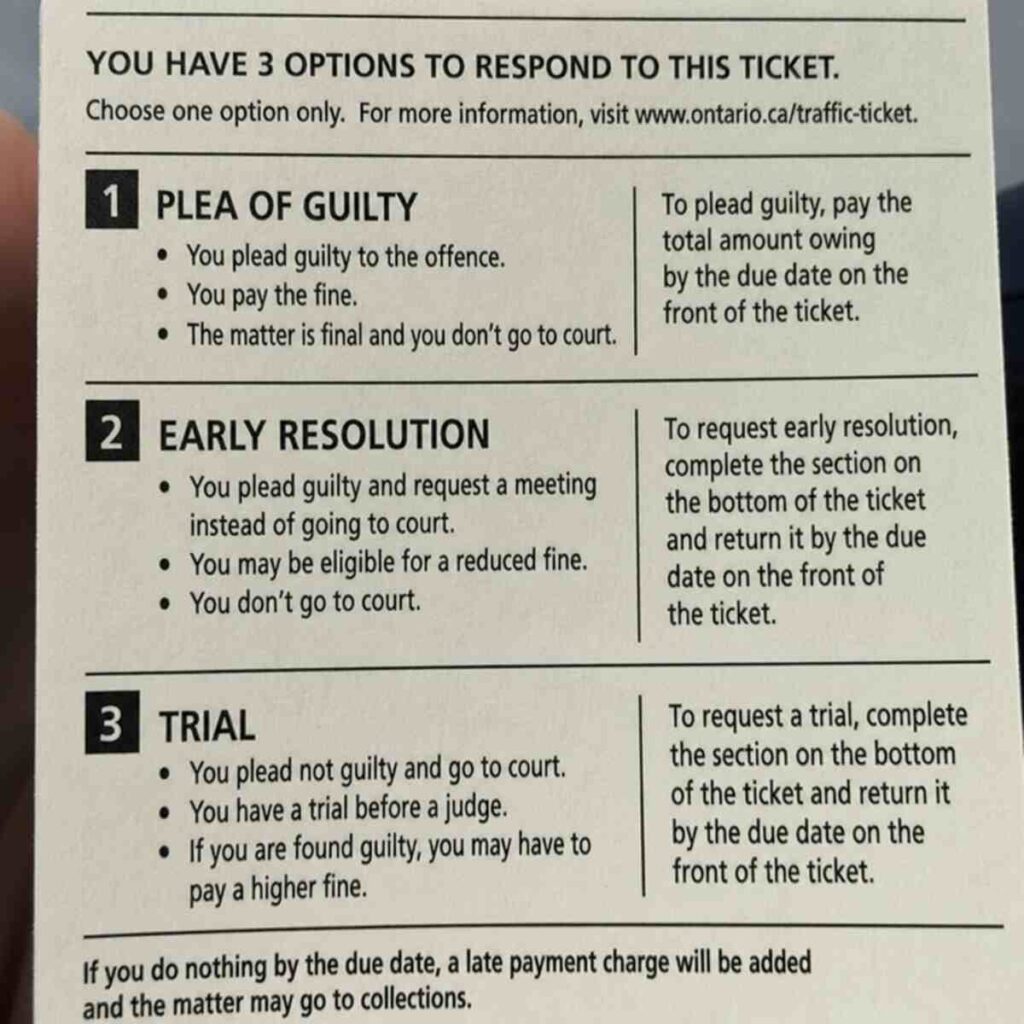
If you flip the ticket over, you will see three distinct options.
Option 1: Plea of Guilty
By choosing this option, you agree to pay the total payable amount. This acts as an immediate conviction. You incur the associated demerit points, and the conviction remains on your record for 3 years. This is almost never recommended if you are concerned about your insurance premiums or driving record.
Option 2: Early Resolution – Meet with Prosecutor
This option allows you to meet with a provincial prosecutor to discuss your case before it goes to trial.
Option 3: Trial Option
This option means you intend to plead not guilty and require the prosecution to prove their case against you in a court of law. To select this, you must formally file a notice of intention to appear with the court.
The Strategy: Early Resolution Meeting vs Trial
One of the most common dilemmas drivers face is choosing between an early resolution meeting vs trial. Both have distinct advantages, but your choice will significantly influence how your case proceeds under the Ontario Provincial Offences Act.
The Early Resolution Route
Choosing Early Resolution means you will be scheduled for a brief meeting with a prosecutor. During the COVID-19 pandemic, many jurisdictions in Ontario shifted these meetings to phone or video calls, and many remain virtual today.
Pros of Early Resolution:
- Time-saving: It is generally faster than waiting for a trial.
- Guaranteed outcomes: You can negotiate a plea deal and know exactly what the penalty will be, removing the uncertainty of a trial.
- Fine reductions: It is an excellent avenue for exploring speeding ticket fine reduction options or negotiating a charge down to an offense that carries zero demerit points.
Cons of Early Resolution:
- You must plead guilty: To get the deal, you must plead guilty to the amended (lesser) charge. A conviction still goes on your record.
- Limited bargaining power: If the prosecutor is unwilling to budge, your only recourse is to reject the offer and request a trial anyway.
The Trial Route
Requesting a trial forces the Crown (the prosecution) to prove beyond a reasonable doubt that you committed the offense.
Pros of a Trial:
- Possibility of a complete win: If the officer fails to show up or if their evidence is flawed, the charges could be completely dismissed.
- Time delays: The court system is backlogged. While you wait for your trial, the conviction stays off your record, protecting your insurance rates in the interim.
- Leverage: You can still negotiate with the prosecutor on the day of your trial before you enter the courtroom.
Cons of a Trial:
- Risk of full penalties: If you lose, you will likely have to pay the full original fine and receive all associated demerit points.
- Time-consuming: Trials require preparation and time away from your day to attend court (either virtually or in person).
Actionable Tip: Many legal professionals recommend always checking Option 3 (Trial). By requesting a trial, you preserve all your legal rights. You can always change your mind and negotiate a plea deal on the day of your trial, but you cannot change an Early Resolution meeting into a trial on the spot if you don’t like the prosecutor’s offer.
Step One of Defense: Requesting Disclosure
If you have selected the trial option, the most crucial step in your traffic ticket defense begins: requesting disclosure.
In the Canadian justice system, you have a constitutional right to know the evidence the prosecution plans to use against you. This evidence is called “disclosure,” and the Crown will not automatically send it to you; you must ask for it.
How to Request Disclosure for Traffic Tickets
- Find the Prosecutor’s Office: Contact the courthouse listed on your ticket and ask for the prosecutor’s office’s email or mailing address.
- Draft a Disclosure Request: Write a formal request. Include your name, contact information, the offense number (found on your ticket), and your scheduled trial date.
- Specify What You Need: A standard disclosure request should ask for:
- A typed copy of the police officer’s handwritten notes.
- A copy of the front and back of the ticket.
- Any dashcam or bodycam video footage.
- Witness statements, if applicable.
- The testing and calibration manual for the radar/laser device (if it is a speeding ticket).
- Keep Records: Always keep a copy of your request and proof of when you sent it (e.g., a fax confirmation or sent email receipt).
Why Disclosure is Your Best Weapon
Reviewing the disclosure allows you to see the case through the officer’s eyes. If the officer’s notes are illegible, incomplete, or contradict the facts of the event, you have a strong foundation for your defense. Furthermore, if the prosecution fails to provide your disclosure after multiple requests, you can motion to have the charges stayed (dropped) at trial because your right to a fair defense was violated.
Analyzing the Evidence: Finding the Flaws
Once you receive your disclosure, it is time to put on your detective hat. You are looking for weaknesses in the Crown’s case.
Common Technical Errors on Traffic Tickets
Many drivers believe that a simple spelling mistake on a ticket—such as a misspelled name or the wrong color of the car—will automatically result in the ticket being thrown out. This is a myth. Under the Ontario Provincial Offences Act, Justices of the Peace may amend “minor” typographical errors on the spot.
However, certain “fatal errors” can result in a ticket being quashed. Look for the following common technical errors on traffic tickets:
- Missing Signature: The officer must sign the ticket. If it is blank, the ticket is fundamentally flawed.
- Missing Offense Date: If the ticket does not state the day, month, and year the offense occurred, it is invalid.
- Incorrect Location: If the officer writes down a street name or intersection that does not exist, the Crown may not be able to prove jurisdictional facts.
- Missing Defendant Information: If the ticket lacks your driver’s license number or name entirely.
Analyzing the Officer’s Notes
The officer’s notes are the backbone of the prosecution’s case. Look for gaps:
- Speeding Tickets: Did the officer note that they calibrated the radar/laser device before and after their shift? If the notes lack calibration details, the speed reading may be deemed inadmissible.
- Stop Sign Tickets: Did the officer explicitly note the position of their vehicle? Did they have a clear, unobstructed view of the stop line?
- Identification: Did the officer write down how they identified you as the driver? (e.g., “Matched photo on DL”).
The Art of Negotiation: Meeting with a Provincial Prosecutor
Whether you are attending an Early Resolution meeting or speaking to the prosecutor on the morning of your trial, knowing how to negotiate is an invaluable skill. The prosecutor’s job is to secure a conviction, but they are also managing a heavy caseload and prefer to resolve matters efficiently without a lengthy trial.
How to Approach the Prosecutor
- Be Professional and Polite: Prosecutors are human beings. Aggressive or rude behavior will not win you any favors. Approach them calmly and respectfully.
- Do Not Admit Guilt During Negotiation: Phrase your statements carefully. Instead of saying, “I know I was speeding, but I can’t afford the points,” say, “I am reviewing the disclosure, and I believe there are issues with the officer’s view of the road. However, to save the court’s time, I am willing to resolve this today if we can agree to a lesser charge.”
- Know Your Goal: Are you strictly trying to avoid demerit points? Are you trying to reduce the fine? Know exactly what you are asking for.
Common Plea Deals in Ontario
When meeting with a provincial prosecutor, you can explore various options:
- Speeding Reductions: If you are caught going 20 km/h over the limit (3 demerit points), the prosecutor might offer to reduce it to 14 km/h over the limit (0 demerit points).
- Charge Substitution: A common tactic is negotiating a moving violation (like failing to yield) down to a lesser municipal by-law infraction, or a minor offense like “disobeying a sign.” These often carry no demerit points and look better to insurance companies than major moving violations.
Preparing for the Courtroom: The Trial Phase
If negotiations fail or you are determined to prove your innocence, your case will proceed to trial. Knowing how to prepare for traffic court trial is the difference between a successful defense and a swift conviction.
Understanding the Courtroom Cast
When you step into an Ontario traffic court, you will interact with several key figures:
- The Prosecutor: The lawyer or paralegal representing the Crown, tasked with proving your guilt.
- The Officer: The police officer who issued the ticket and serves as the prosecution’s primary witness.
- The Justice of the Peace: In traffic court, you will not see a traditional judge. Instead, you will see a Justice of the Peace (JP). The role of a Justice of the Peace is to preside over the courtroom, hear the evidence, ensure that legal procedures are followed, and ultimately deliver a verdict. You must address the JP as “Your Worship.”
Structuring Your Trial Preparation
To succeed at trial, you need a meticulous plan:
- Develop a Theory of Defense: Why are you not guilty? Was the radar gun faulty? Was the traffic sign genuinely obscured by overgrown trees? Your entire cross-examination and testimony should revolve around this central theory.
- Prepare Your Evidence: If your defense relies on an obscured sign, you must bring clear, date-stamped photographs of the intersection taken as close to the time of the offense as possible. Print multiple copies (one for you, one for the prosecutor, and one for the JP).
- Prepare for Cross-Examination: This is where cases are won or lost. You will have the opportunity to question the police officer.
Mastering Cross-Examination
The goal of cross-examination is not to argue with the officer but to highlight inconsistencies, memory lapses, or omissions in their testimony.
- Ask Leading Questions: These are questions that suggest the answer and typically require a “yes” or “no” (e.g., “Officer, it was raining heavily that evening, wasn’t it?”).
- Box Them In: Use the officer’s disclosure notes against them. If they testify to a detail in court that is missing from their notes, ask: “Officer, your notes are written while your memory is fresh, correct? And you include all important details in your notes, correct? Yet, there is no mention of other traffic in your notes today.”
- Never Ask “Why”: Asking open-ended questions gives the officer a chance to explain away their mistakes and strengthen the prosecution’s case.
Giving Your Testimony
After the prosecution rests its case, you have the right (but not the obligation) to testify. If you testify, the prosecutor will get to cross-examine you. Speak clearly to the Justice of the Peace, stick strictly to the facts, and do not let the prosecutor rattle you during their cross-examination.
Section 11(b): The Charter Right to a Speedy Trial
One of the most powerful tools in a traffic ticket defense strategy has nothing to do with the facts of your driving, but rather the speed of the justice system itself.
Under Section 11(b) of the Canadian Charter of Rights and Freedoms, every person charged with an offense has the right to be tried within a reasonable time. Due to systemic backlogs, Ontario traffic courts frequently experience severe delays.
The “Jordan” Framework
In a landmark Supreme Court of Canada case (R. v. Jordan), the court established strict timelines for criminal and provincial offenses. For provincial offenses like traffic tickets in Ontario, the presumptive ceiling from the date the charge is laid to the conclusion of the trial is 18 months.
If your trial is scheduled beyond this 18-month window, you can file a formal constitutional application to withdraw the charges due to trial delays.
How to Argue a Section 11(b) Delay
You cannot simply show up on your trial date and complain that it took too long. Successfully arguing a Section 11(b) delay requires procedural strictness:
- Serve Notice: You must draft a formal Notice of Constitutional Question.
- Serve the Right Parties: This notice must be served to the Attorney General of Ontario, the Attorney General of Canada, and the local prosecutor’s office at least 15 days before your trial.
- Calculate the Delay Properly: You must calculate the exact number of days from the offense date to the trial date. You must then subtract any delays you caused (e.g., if you requested a postponement to go on vacation). If the net delay exceeds 18 months, the burden shifts to the Crown to justify the delay (usually by claiming exceptional circumstances, which are hard to prove).
If the Justice of the Peace agrees with your application, your charges will be “stayed.” This is essentially the equivalent of a dismissal; the case is thrown out, and no conviction is recorded.
High-Stakes Defense: Fighting Stunt Driving Charges
While a minor speeding ticket is a nuisance, some charges carry life-altering consequences. In Ontario, Part III offenses—which require a mandatory court appearance rather than offering a simple fine payment—are incredibly serious. The most common and heavily prosecuted of these is Stunt Driving.
What Constitutes Stunt Driving?
Under Section 172 of the Highway Traffic Act, stunt driving includes racing, doing “doughnuts,” preventing other vehicles from passing, and most commonly, excessive speeding. Specifically, you can be charged with stunt driving for:
- Driving 40 km/h or more over the speed limit on roads with a limit of less than 80 km/h.
- Driving 50 km/h or more over the speed limit on roads with a limit of 80 km/h or higher.
- Driving 150 km/h or more on any road, regardless of the speed limit.
The Immediate and Long-Term Penalties
Fighting stunt driving charges requires urgent attention because the penalties begin the moment you are pulled over.
- Roadside Penalties: An immediate 30-day driver’s license suspension and a 14-day vehicle impoundment (even if the car belongs to someone else, like a rental company or a parent).
- Conviction Penalties: If convicted in court, you face a minimum fine of $2,000 (up to $10,000), six demerit points, a mandatory 1-to-3-year license suspension for a first offense, and the very real possibility of up to six months in jail. Furthermore, your insurance rates will become virtually unaffordable, easily tripling or quadrupling.
Defending a Stunt Driving Charge
Due to the severity, DIY defense is highly discouraged. A solid defense against stunt driving often revolves around:
- Challenging the Radar/Laser Evidence: Rigorously cross-examining the officer regarding their use of the speed-measurement device. Was it tested? Was there interference from other large vehicles on the highway?
- Charter Challenges: Examining if your rights were violated during the roadside stop or if there are unreasonable trial delays.
- Negotiating Down: An experienced representative may be able to negotiate a stunt-driving charge down to a standard speeding charge. While a speeding conviction still impacts insurance, it avoids the catastrophic license suspensions, jail time, and massive fines associated with stunt driving.
Seeking Professional Help: Making the Right Choice
As you can see, navigating the Ontario Provincial Offences Act court process is highly technical. While you have the right to represent yourself, securing professional legal representation can vastly increase your chances of a favorable outcome. When looking for help, you generally have two options.
Traffic Ticket Paralegal vs Lawyer
In Ontario, both lawyers and licensed paralegals can represent you in traffic court.
Traffic Ticket Paralegals: Paralegals in Ontario are licensed and regulated by the Law Society of Ontario. Many paralegals specialize exclusively in traffic tickets and provincial offenses.
- Pros: They are usually more affordable than lawyers. Because they are in traffic court every single day, they are intimately familiar with the Justices of the Peace, the local prosecutors, and the specific nuances of traffic law. They know which prosecutors are willing to make deals and which JPs are strict on certain types of evidence.
- Cons: They are restricted in the types of law they can practice. If your traffic ticket involves a concurrent criminal charge (such as impaired driving or dangerous driving under the Criminal Code), a paralegal cannot represent you in the criminal matter.
Lawyers:
- Pros: Lawyers can handle any type of case, from a simple stop sign violation to a complex Criminal Code driving offense. If your case involves severe injuries, fatalities, or criminal charges, a lawyer is absolutely necessary.
- Cons: They are significantly more expensive than paralegals. Furthermore, many lawyers focus on broader areas of criminal or civil law and may not have the same day-to-day, localized experience in provincial traffic court as a specialized paralegal.
Is Hiring Representation Worth the Cost?
When weighing the cost of a legal professional against simply paying the ticket, you must factor in the long-term costs. A paralegal might charge $400 to $800 to fight a standard speeding ticket. However, if that ticket causes your auto insurance to increase by $500 a year for three years ($1,500 total), paying for a professional to get the charge dropped or reduced is a financially sound investment.
When you hire a professional to fight traffic tickets ontario drivers can benefit from a completely hands-off experience. In most cases, your representative can file your notice of intention to appear, order and review disclosure, attend early resolution meetings, and conduct the trial on your behalf without you ever needing to step foot in a courthouse or take time off work.
Conclusion: Taking Control of Your Driving Record
Receiving a traffic ticket in Ontario is a daunting experience, but it does not have to be a permanent stain on your driving record or a drain on your finances. By understanding the true consequences of a conviction—particularly its severe impact on insurance premiums—you empower yourself to make informed, strategic decisions.
Whether you decide to carefully prepare your own traffic ticket defense or hire an experienced professional, the key is taking action. Pay close attention to Provincial Offences Court filing deadlines, never ignore the vital step of requesting disclosure for traffic tickets, and approach every stage of the Ontario Provincial Offences Act court process with preparation and professionalism.
By utilizing the strategies outlined in this guide—from scrutinizing common technical errors on traffic tickets to understanding the nuances of an early resolution meeting vs trial—you give yourself the best possible chance to successfully Fight Traffic Tickets in Ontario, preserve your driving privileges, and keep your hard-earned money in your pocket. Stay informed, drive safely, and defend your rights on the road.