


Simon Game Variations to Try
Remember that flashing, beeping circle from the 80s? For many, the Milton Bradley original Simon game was the ultimate test of memory, a true icon among classic 80s electronic games. The rules were simple: watch the pattern of lights and sounds, then repeat it. One wrong move and that deep, disappointing buzz signaled you were out. That simple, addictive challenge is now more accessible than ever. Check out nemo189 to know more
Today, that same test of focus has moved from the tabletop to your browser. A quick search for a simon game online pulls up hundreds of versions, from perfect replicas to bizarre new takes on the classic. This creates a new problem: which one is worth your time? Are they all the same, and how do you even play if you’ve never seen the original toy?
This guide will re-introduce the simple rules of the classic game and provide a direct, safe link to play. Once you’ve refreshed your memory skills, we’ll explore several modern variations that add new twists to the formula and consider whether playing these games is just a fun distraction or an actual workout for your brain.
How to Play the Simon Game in Under 60 Seconds
The beauty of the Simon game is its simplicity. Your one and only job is to perfectly repeat a pattern of lights and sounds. The catch? The pattern gets one step longer every time you get it right. It’s a pure test of focus and memory, making it a perfect quick break or a fun challenge against your friends.
Ready to give it a try? Here’s exactly how a typical game round of this online sequence memory game works:
- Watch the First Step: The game will begin by lighting up one color (like Green) and playing a matching sound.
- Copy What You Saw: Now it’s your turn. Press the Green button.
- The Pattern Grows: The game will repeat the first step (Green) and then add a new one (maybe Blue).
- Repeat the Whole Sequence: Your job is to press the colors in the correct order: Green, then Blue.
The game continues this way, adding one more color to the end of the sequence each time you succeed. But be careful—the rules are strict, much like the classic “Simon Says.” The moment you press a color out of order, the game is over! Your final score is the length of the longest pattern you correctly remembered. The only question is, how high can you score?
Variation #1: The Classic Simon Game Online
The rules you just learned are the heart of the original experience. When you search for the best free simon memory game, the “classic” version is the perfect place to start. It’s the most common and direct recreation of the famous electronic toy that captivated a generation. This version is all about pure, focused memory without any extra frills or distractions, making it ideal for both nostalgic players and absolute beginners just learning the ropes.
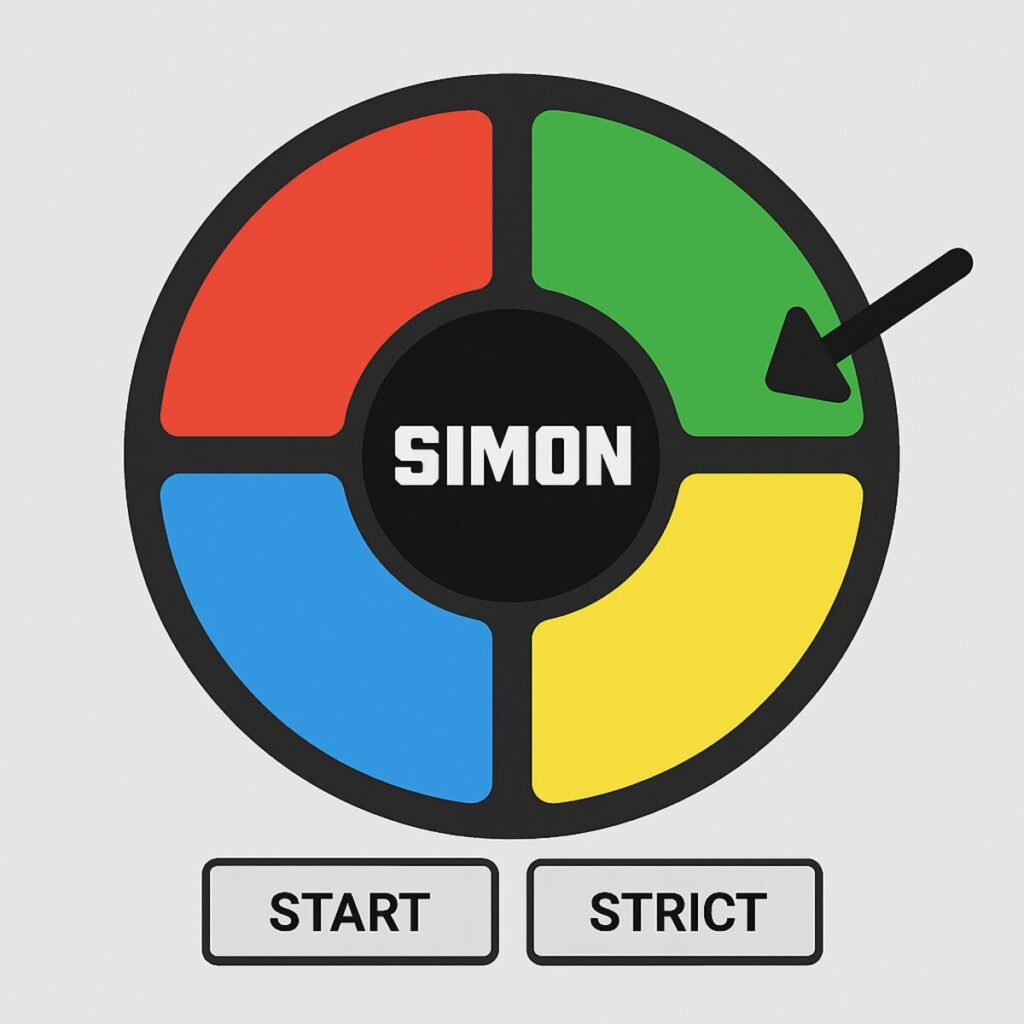
You’ll recognize a faithful classic version by its simple, iconic interface. It almost always features four large, colorful buttons—red, green, blue, and yellow—typically arranged in a circle. The sounds are just as important, with each color having a distinct, simple electronic tone. This design is a direct nod to the Milton Bradley original simon game from the 1980s, creating an experience that feels both vintage and timeless. If you see this clean, four-color setup, you know you’re in the right place to play simon says online the way it was first intended.
What makes this variation the standard is its straightforward challenge. The game’s speed remains constant, and the sequence simply grows one step at a time. There are no timers, no bonus points, and no surprise twists to throw you off. The difficulty comes entirely from your own ability to recall the ever-lengthening pattern. This creates a smooth, predictable rhythm that lets you focus on one thing and one thing only: how long of a sequence can you remember? It’s the purest test of short-term memory.
Ready to see how you stack up against the original challenge? You can play a fantastic, free version of the classic game right in your browser.
(Find a trusted, ad-free version to link here for the reader)
Once you feel comfortable consistently reaching a high score and the steady pace of the classic game feels too predictable, you might be ready for a new twist. For those who want to test not just their memory but also their reflexes, the next step is a faster, more intense challenge.
Variation #2: Super Simon for a Faster Challenge
If the steady rhythm of the classic game starts to feel a bit too comfortable, you’re ready for the next step in simon game difficulty levels: speed. Often called “Super Simon” or “Speed Simon,” this variation takes the core rules and puts them on fast-forward. As your sequence gets longer, the game also increases the speed at which it flashes the colors. What starts as a manageable pace can quickly become a frantic race against your own reflexes, forcing you to think and act much faster.
This faster version is perfect for players who want a more thrilling, high-energy challenge. If your mind tends to wander during the slower pace of the classic mode, the added speed will demand your complete attention. It transforms the experience from a purely mental exercise into a test of both memory and reaction time. This makes it a fantastic online sequence memory game for anyone who enjoys a little adrenaline and wants to see how well they can perform under pressure.
When the patterns start flashing by in a blur, you may find a common simon game patterns strategy is no longer enough. Here’s a pro tip: try assigning a number to each color in your head (e.g., Green=1, Red=2, Blue=3, Yellow=4). Thinking or whispering “1-2-1-3” is much faster than saying “Green-Red-Green-Blue,” which can give you the split-second advantage you need to keep up with the game’s blistering pace.
Getting a high score in a speed round is a rush, proving that your brain can recall information accurately even when the clock is ticking. It adds an exciting layer of difficulty without changing the fundamental goal of the game. But what if the challenge wasn’t about speed, but about thinking backward? For a truly mind-bending test, the next variation flips the rules completely upside down.
Variation #3: Reverse Simon to Flip Your Brain Upside Down
Just when you think you’ve mastered remembering patterns, this variation flips the entire game on its head. In Reverse Simon, the goal is not to repeat the sequence you see, but to repeat it in the opposite order. For example, if the game flashes Red → Blue → Green, you must press Green → Blue → Red to succeed. This simple twist turns a familiar challenge into a brain-bending puzzle, demanding a new way of thinking.
This mode tests your brain in a completely different way. You can’t just react; you have to actively hold the original sequence in your head while mentally rearranging it before you press a single button. It’s one of the most effective games that improve short-term memory because it forces you to manipulate information, not just recall it. This two-step process—remembering and then reversing—is a powerful mental workout that feels distinctly different from the standard game.
The difficulty of this mode might surprise you. Even a short sequence of four or five colors can feel incredibly challenging to reverse under pressure. Think about how easy it is to say the alphabet forward, but how much concentration it takes to say it backward. That’s the exact feeling you get from this unique online memory game. It’s not your memory that’s failing; it’s the mental gymnastics of reordering the pattern that provides the real test.
For players who love puzzles and want to push their concentration to its limits, Reverse Simon is one of the most rewarding simon game difficulty levels available. It’s less about pure reflex and more about deliberate mental processing. But what if the challenge wasn’t just in how you think, but in how you play? For those who prefer the feel of a keyboard, another variation offers a more tactile twist.
Variation #4: Keyboard Simon for a Tactile Twist
For those who prefer the satisfying click of a keyboard to the glide of a mouse, this variation offers a completely different feel. Instead of pointing and clicking on the colored panels, you control the entire game using designated keys on your keyboard. This simple change can make the game feel faster, more responsive, and a little closer to the feel of pressing the chunky buttons on the original 1980s toy. If you want to play simon says with keyboard, this version is made for you.
The setup is incredibly straightforward. The game assigns one key to each color, allowing your fingers to rest in a “home” position, ready to react. While the exact keys can vary, a common layout might look like this:
- A Key = Green (top-left)
- S Key = Red (top-right)
- K Key = Yellow (bottom-left)
- L Key = Blue (bottom-right)
Other versions might use the arrow keys, but the idea is the same: one key, one color. This removes the need to move a mouse cursor, letting you rely purely on muscle memory.
This keyboard-centric approach often helps players improve their speed and accuracy. Once you learn the key positions, your fingers can fire off responses much quicker than you could ever move and click a mouse. There’s no risk of your cursor slipping at a crucial moment. This makes the simon game online feel less like a pointing exercise and more like a rhythm game, where timing and finger dexterity become part of the challenge.
Ultimately, this variation of the classic online sequence memory game is perfect for touch-typists, gamers, or anyone who enjoys a more physical and tactile challenge. It’s a fantastic way to warm up your fingers while giving your brain its daily workout. But what if the real challenge wasn’t just remembering a pattern, but doing it faster than someone else?
Variation #5: Multiplayer Simon to Challenge Your Friends
While beating your own high score is rewarding, the real fun often begins when you bring other people into the mix. Multiplayer Simon transforms the solo memory challenge into a lively head-to-head competition, making it one of the most engaging online games with friends. Instead of just testing your own limits, your new goal is simple: outlast or out-speed your opponent.
The most common format is a turn-based duel. In this mode, you and a friend take turns tackling the same growing sequence. The game shows a pattern, you repeat it, and then it’s your friend’s turn to do the same. The sequence gets longer with each successful round, passing back and forth until one person finally makes a mistake. It’s a tense battle of wits where a single slip-up can cost you the game.
A more intense version of the simon game online pits players against each other in a real-time race. Both players see the same pattern simultaneously and must input it as quickly and accurately as possible. Here, it’s not just about remembering the sequence, but about having the fastest fingers. This format turns the game into a high-speed test of reflexes and memory under pressure, where the first to finish the pattern correctly wins the round.
Ultimately, these multiplayer modes change the entire feel of the game. It’s no longer just a personal puzzle; it’s a social multiplayer memory game filled with friendly rivalry and bragging rights. Competing against others adds a dynamic layer of excitement that a solo high-score chase can’t match. But while battling friends is a thrill, what if you could take control and create the exact challenge you wanted to play?
Variation #6: Custom Simon to Be Your Own Game Designer
Beyond competing with friends, the ultimate way to master Simon is to build the game you want to play. Many websites that let you customize online games offer a “custom mode” for Simon, essentially handing you the controls to create a personalized challenge. Instead of just reacting to the game, you get to set the rules.
With these settings, you can control the core elements that define the experience. Imagine making the patterns flash slower for a relaxed practice session, or speeding them up for a true reflex test. You can often adjust the simon game difficulty levels by adding more colors to the sequence—going from the classic four to five or even six. Some versions even act as a simon says color sequence generator, letting you turn off sounds to rely purely on visual memory.
This level of control transforms the game into a powerful training tool. If you’re just starting out, you can set the speed to ‘slow’ and use only three colors to comfortably learn the patterns. As you get better, you can gradually increase the difficulty, adding another color or slightly bumping up the speed. It’s a fantastic way to improve at your own pace, ensuring you are always challenged but never overwhelmed.
Creating a custom game isn’t just about fun; it’s about tailoring the experience to your personal skill level. By designing your own challenges, you’re actively engaging with the game on a deeper level. This level of control transforms the game into a powerful training tool, raising an important question: does all this memory practice actually make your brain sharper?
Is the Simon Game Actually Good for Your Brain?
So, is playing Simon good for your brain? The short answer is yes—playing Simon is good for your brain, but it’s more like a targeted workout than a general intelligence boost. Every round challenges one specific mental muscle: your short-term memory. This classic sequence memory game is designed purely to test your ability to hold a small piece of information in your mind and recall it just moments later.
Think of it like remembering a phone number someone just told you. You hold those digits in your head just long enough to dial them, and then you let them go. Simon does the exact same thing with lights and sounds. Each new color added to the pattern forces you to actively rehearse the sequence, strengthening that exact mental skill. This is why games that improve short-term memory feel both challenging and satisfying; you can feel your brain working.
While it probably won’t help you memorize a textbook, think of it as a healthy mental stretch. It’s a fun way to keep your mind engaged and nimble, sharpening your focus in the moment. And just like any exercise, a little strategy goes a long way. A few simple tricks can help you dominate the game and take your memory workout to the next level.
3 Simple Tricks to Finally Beat Your High Score
Feeling stuck once the pattern gets past seven or eight colors? You’re not alone. At that point, the game becomes a real mental challenge. Instead of relying on raw memory, you can use the same techniques as professional memory athletes. Here are three simple simon game high score tips that can help you crush your old record.
Most people find it much easier to remember information when it’s organized into a real simon game patterns strategy.
- Group the Colors (“Chunking”): Don’t try to remember “Red-Green-Green-Blue-Yellow-Red.” Instead, break it into smaller, phone-number-style groups. Think of it as “Red-Green-Green” and “Blue-Yellow-Red.” Your brain can handle two small groups much easier than one long, chaotic string.
- Say It Out Loud: As the colors flash, whisper them to yourself. This technique, sometimes called verbalization, adds a second layer to your memory. You’re not just seeing the pattern; you’re also hearing it, which helps lock it in.
- Create a Silly Story: This is the most powerful trick for a long sequence. Turn the colors into a simple narrative. For a pattern like “Red-Blue-Green,” you could imagine, “A red car drove into a blue lake to find a green frog.” It sounds goofy, but turning an abstract pattern into a concrete story makes it surprisingly unforgettable.
The best part is that you can mix and match these techniques to find what works for you. Knowing how to win simon game is less about luck and more about having a plan.
Simon vs. Bop It: Which Game Is Right for You?
While Simon and Bop It are both iconic electronic games that beeped their way through living rooms, they test completely different skills. Choosing between them is like deciding if you want to run a mental marathon or a physical sprint. Both are considered classic 80s electronic games, but the simon game vs bop it debate comes down to one simple question: do you want to test your mind or your reflexes?
Simon is a game of pure memory and focus. The challenge is entirely in your head as you quietly watch and repeat an ever-growing sequence of colors. It’s a slow-burn puzzle that rewards patience and concentration. In contrast, Bop It is a frantic test of physical speed. The game barks commands—”Bop it! Twist it! Pull it!”—and you must react instantly. It’s less about remembering a long pattern and more about how quickly your hands can follow orders under pressure.
So, which challenge fits your mood today?
- Simon: Tests pure memory. The pace is slow, steady, and deliberate.
- Bop It: Tests physical reflexes. The pace is fast, frantic, and reactive.
Ultimately, the right game depends on whether you’re looking for a quiet mental workout or a noisy burst of action.
Which Simon Will You Master First?
From the timeless Classic version to the rapid pace of Super Simon or the tricky patterns in Reverse Simon, the game offers more than just repeating colors. Each variation is a unique way to give your brain a rewarding workout and discover which challenge you enjoy the most.
The only thing left is to begin. Will you build your confidence with the Classic game or jump straight into a tougher mode? It’s time to test your memory and see what you’re capable of.
